Multiline
-M (--multiline) joins several physical lines into one event before
parsing — stack traces, wrapped messages, pretty-printed payloads. The
guide shows when to use it;
this page has the details. kelora --help-multiline is the terminal version.
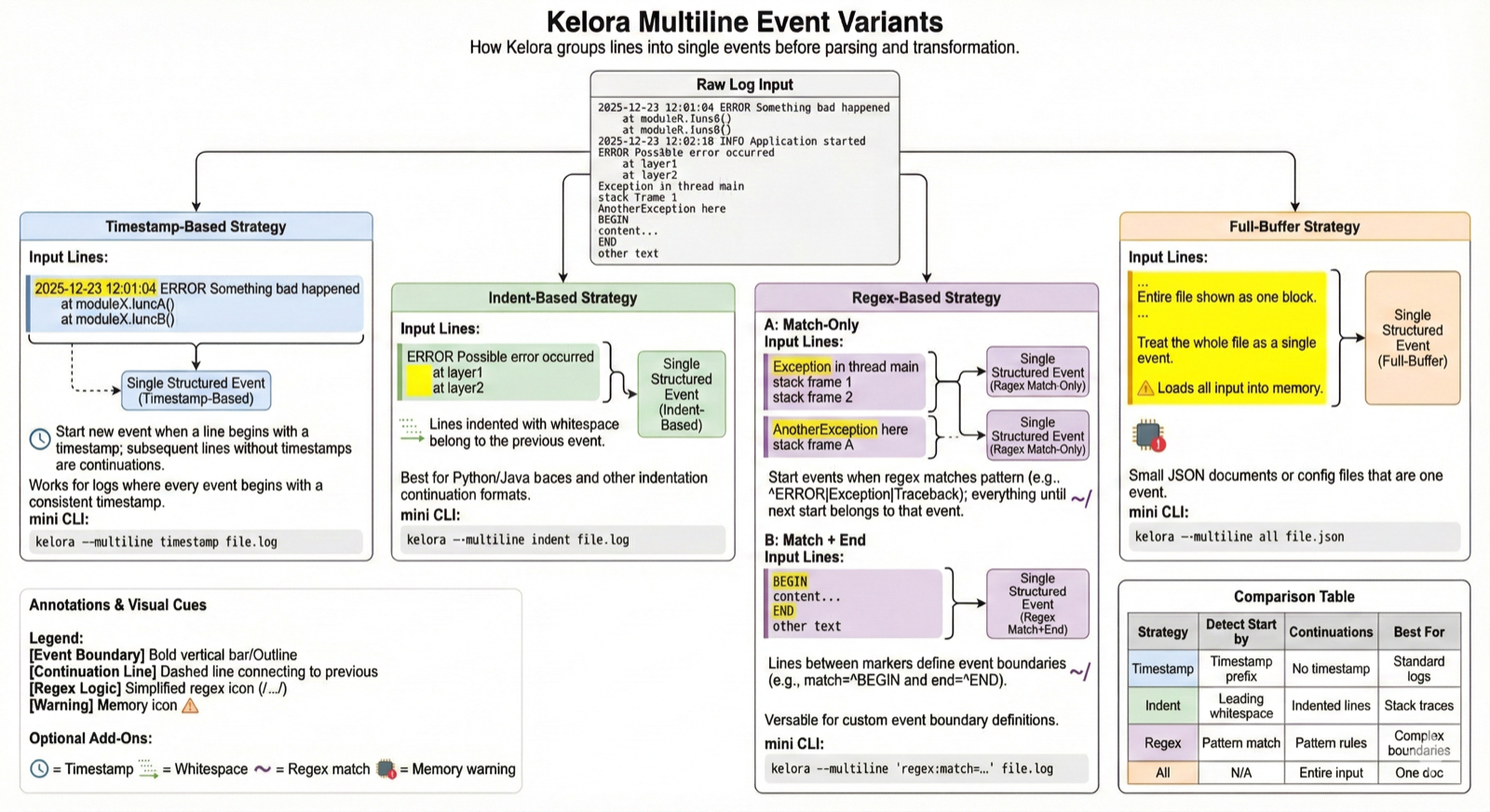
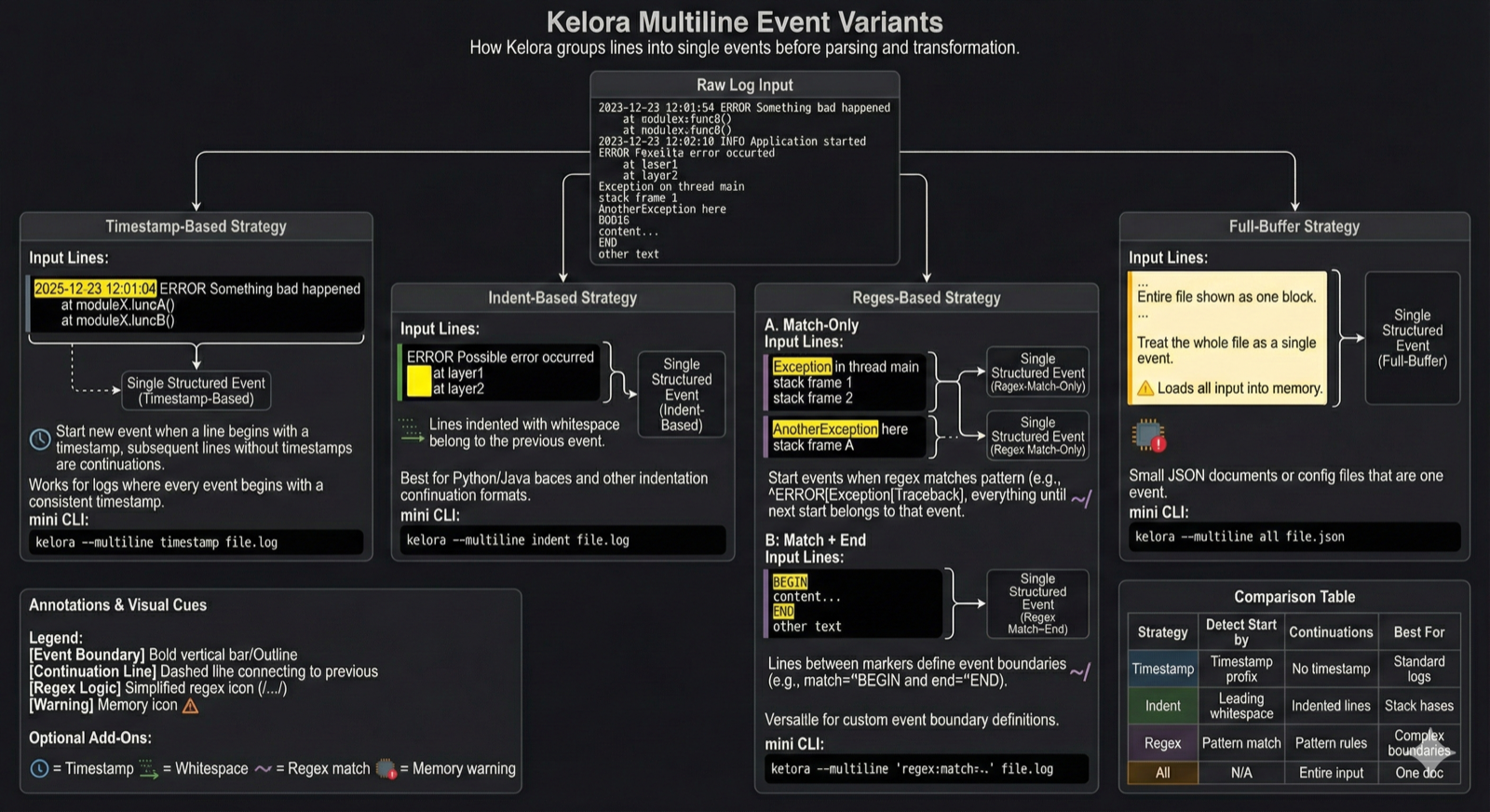
Strategies
| Strategy | A new event starts at | Notes |
|---|---|---|
timestamp |
a line beginning with a timestamp | locks onto the first timestamp format it sees |
timestamp:format=FMT |
a line beginning with a timestamp in this chrono format | e.g. timestamp:format=%d/%b/%Y:%H:%M:%S %z |
timestamp:loose |
a line beginning with any recognizable timestamp | for files that genuinely mix formats |
indent |
a line that is not indented | indented and blank lines continue the event |
blank |
the first line after one or more blank lines | the blank lines belong to no event |
regex:match=RE |
a line matching RE | |
regex:match=RE:end=RE2 |
a line matching RE; the event ends at a line matching RE2 | lines between events become their own events |
java, python, go |
any line that is not part of a recognized stack trace | for output without timestamps |
all |
— | the whole input is one event, held in memory |
Only one strategy is active at a time.
timestamp
The default choice for application logs. Detection locks onto the first
timestamp format it sees, so a continuation line that merely starts with
something time-like (17:03 was the incident window) does not split an event.
If the first line isn't a real header, pin the format with
timestamp:format=….
indent
For continuation lines that start with whitespace (Java traces, YAML). If the
first line of a block is itself indented, or a trace starts with an unindented
line such as Traceback (most recent call last): or Caused by:, use
timestamp or a language preset instead.
Language presets: java, python, go
For stack traces in output without reliable timestamps: raw stderr, container stdout, CI logs. Every line is its own event unless it belongs to a recognized trace; a trace attaches to the line that logged it.
| Preset | Recognizes |
|---|---|
java |
exception lines, at … frames, Caused by:, Suppressed:, ... N more |
python |
Traceback (most recent call last):, frames, the final exception line, chained exceptions, exception groups, SyntaxError blocks |
go |
panic:, fatal error:, [signal …], goroutine headers and frames, blank lines between goroutine blocks |
A line starting with a timestamp always starts a new event, so presets are safe
on timestamped files — but timestamp is better there, because it also keeps
non-trace continuation lines with their event. A multi-line exception
message is recognized only up to its first line.
regex
kelora examples/multiline_boundary.log -f raw -M 'regex:match=^BEGIN:end=^END' \
  --multiline-join=newline -n 1 -F json
{"raw":"BEGIN\ntype: database_backup\ntimestamp: 2024-01-15T10:00:00Z\nstatus: started\ntarget: postgresql://production\nEND"}
Patterns may contain colons (match=^\d{2}:\d{2}); only :match=, :end=,
and :format= act as separators.
Joining lines
--multiline-join |
Joins with | Default for |
|---|---|---|
space |
a space | timestamp, indent, blank, regex |
newline |
\n |
all, java, python, go |
empty |
nothing | — |
Use newline to keep a stack trace readable or to split("\n") it in a
script.
Parsing a joined event
Grouping happens before parsing, so the joined block must still match the format:
-f rawand-f lineaccept anything.regex:patterns ending in(?P<msg>.*),-f syslog, and the built-in application formats (log4j,python-logging,iso8601-level, …) capture the continuation lines in the message field, newlines included.- Strict formats (
logfmt,combined,jsonfor a single-line object) fail on a block with stack frames in it, and the whole event is dropped — so turning multiline on can reduce the number of events. Kelora hints at this when a parse error lands on a grouped event.
Streams, timeouts, and limits
| Option | Default | Effect |
|---|---|---|
--multiline-timeout DUR |
off for files, 400ms for stdin/FIFOs |
emit a buffered event after this much input inactivity; 0 = never |
--multiline-max-lines N |
10000 |
split an event after N lines and warn; 0 = unlimited; ignored by all |
Other rules:
- Events never span input files.
--keep-linesand--ignore-linesact on physical lines before grouping.meta.line_numpoints at the event's first line.- Trailing blank lines are trimmed from events (except with
all).
Troubleshooting
| Symptom | Likely cause and fix |
|---|---|
| every line is still its own event | the start rule never matched — Kelora hints once; check the regex, or use timestamp only if timestamps sit at the start of the line |
| everything is one event | same cause with an end-less rule; the line cap splits after 10 000 lines with a warning |
| events merge that should split | timestamp locked onto the wrong format: use timestamp:format=… |
warning joined N lines into M events |
the start rule recognizes only some records (lines that don't begin with a timestamp, a too-narrow regex:match=), so the rest are glued on. Fires at 3+ lines per event over 50+ lines when most joined lines start at column 0; indented stack traces don't trigger it |
| events split on a live stream | a pause longer than the timeout: raise --multiline-timeout |
fewer events with -M than without |
joined blocks no longer parse: use a free-text format (see above) |
| a preset splits a trace | unusual trace shape: check with -f raw -F json -n 5; fall back to regex: |
--stats shows lines read versus events created, which is the quickest way to
see what grouping did.